Towards a New Mainstream Journalism – Built by You
On our seventh birthday, help us bring independent reader-powered journalism to more people than ever before.
#SevenYears
| £ 5 | ||
| £ 10 | ||
| £ 20 | ||
| £ 100 | ||
| £ 200 | ||
| £ |
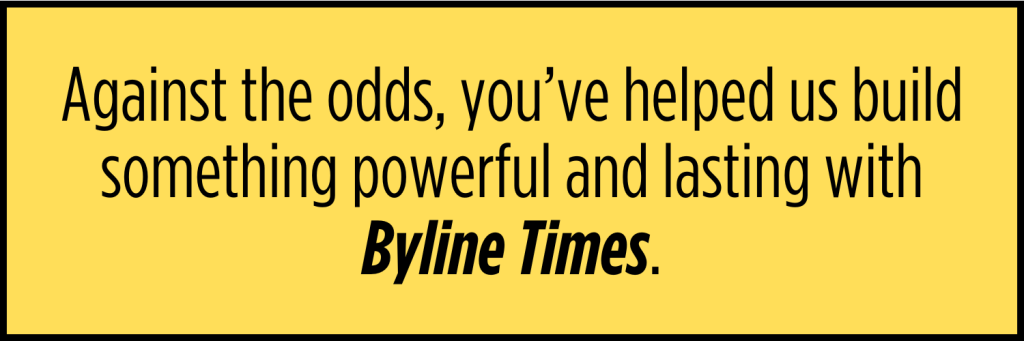
Byline Times launched seven years ago as an audacious experiment: could independent journalists, funded only by their readers, compete with Britain’s monopoly press machine?
Against expectations, the answer was yes. What began as an online blog in 2019 (first printed only for friends and family) is now a national monthly stocked in major UK retailers. We’ve grown from dozens of supporters to tens of thousands, building a community of subscribers, shareholders and readers across the UK and beyond. Our Political Editor sits in the Parliamentary Lobby, and our contributors include mayors, MPs, whistleblowers, barristers and academics.
Together, we’ve built something improbable. While much of the mainstream media – from the BBC in Britain to CBS News in the United States – has been hollowed out by capture and capitulation, we’ve created something different: a media institution powered by readers and accountable only to the facts.
The powerful would prefer you misinformed and disengaged. They would love to buy us and control our agenda. They sanction us, block our reporters and bar us from events. They don’t want outlets like Byline Times investigating, scrutinising and building communities beyond the mainstream bubble.
Because we’ve shown we can make a difference. For six years Byline Times called for a foreign agents registration scheme – enacted in 2025. Our reporting on crimes against humanity in Kherson informed findings presented at the United Nations. From the COVID PPE scandal to GB News’ Dan Wootton, BBC impartiality disputes, Israel’s historic crimes in Gaza, the Nathan Gill affair and the Epstein Files, we’ve been there early to shape the national – and sometimes international – debate.
Democracy Throttled
Ahead of the Gorton & Denton by-election this year, Reform UK accused Byline Times of “attempting to derail a democratic election” after we reported on candidate Matt Goodwin’s ties to a rebranded Nazi eugenics organisation. After losing, Farage’s party immediately began promoting Trump-style claims of election fraud.
To us, the pattern is clear: Reform UK operates as a forward base for Trumpism on British soil. The playbook is familiar – discredit and harass critical media, scapegoat and distract, flood the zone, and question any democratic result that doesn’t go your way.
We’ve seen off threats from lawyers, media monopolists, from the oligarchs and broligarchs who twist journalism to suit the 1%. But we still face their attempts to repress genuine news and investigations. Our social reach has been crushed by Zuckerberg on Facebook and Musk and X, and now by Google, which, by using AI to replace its search functions, has strangled traffic to news sites by 80%.
It couldn’t be clearer that Britain needs stronger media institutions. With few exceptions, our obsequious press indulges right-wing conspiracies, deceptively frames issues, and ignores hard realities. It simply isn’t doing its job.
And the months ahead will only test democracy further. Local elections in May will bring fresh political turmoil. US midterms later this year will once again test America’s embattled system. War engulfs the Middle East, tech broligarchs consolidate power, and the far-right continues its long march.
A project built with that understanding must rise to meet the moment. With your help, Byline Times can break into the mainstream.
A National Media Brand
We hear it often from subscribers. People tell us that they love our reporting, but that we need to get Byline Times out there – to get in front of more people. To break into the mainstream. The big papers in this country get to set the national agenda. Imagine if reader-funded news had that reach and those resources?
The most powerful tool at our disposal is you. This community built Byline Times from a blog into a highly-regarded alternative periodical. But the next phase of this project – something we’d have never originally thought possible – is to turn this into a national media brand.
We can kindle our own light in the dark. We can light the way for those weighed on by the heavy news cycle, giving them sanctuary instead of letting them slip into apathy and ignorance.
Your contribution to this crowdfunder will power a massive marketing campaign for Byline Times – every £10 we receive translates into roughly 3,000 new readers. Potential new members of this community.
And that’s not all.
- We’re setting up partnership deals with trade unions and universities to bring new audiences in;
- We’re launching a ‘give one forward’ plan, sending our subscribers bonus copies to give to friends and family;
- We’re putting Byline Times on the map at music festivals like WOMAD and the Together Alliance’s march to stop the far-right.
We’re working with Fêtes of London and setting up Byline Times News Clubs: engaging people around the nation with our newspaper and sparking illuminating conversations and debates about politics and the news.
Fighting the Good Fight
The anti-democratic forces narrowing public debate are powerful: well-funded, networked and relentless. But they are not inevitable. They depend on distraction, fatigue and the slow erosion of standards. They rely on a public that turns away.
We were founded on the opposite belief: that people are not powerless. That readers will support journalism that treats them as citizens rather than consumers. That truth pursued steadily and without deference still matters.
Byline Times exists because thousands of you chose to make it exist. On our seventh birthday, we ask you to help us launch the next chapter.
Seven years ago we proved independent journalism could survive.