Tracking and cookies.
Ukrainian Resilience Four Years On:
‘I Do Not Deal With Peace, Because I Have to Deal With War’
Olesya Khromeychuk visited Kyiv ahead of the fourth anniversary of Russia’s full-scale invasion of Ukraine and reflects on what survival really involves for those who have to live through it every day
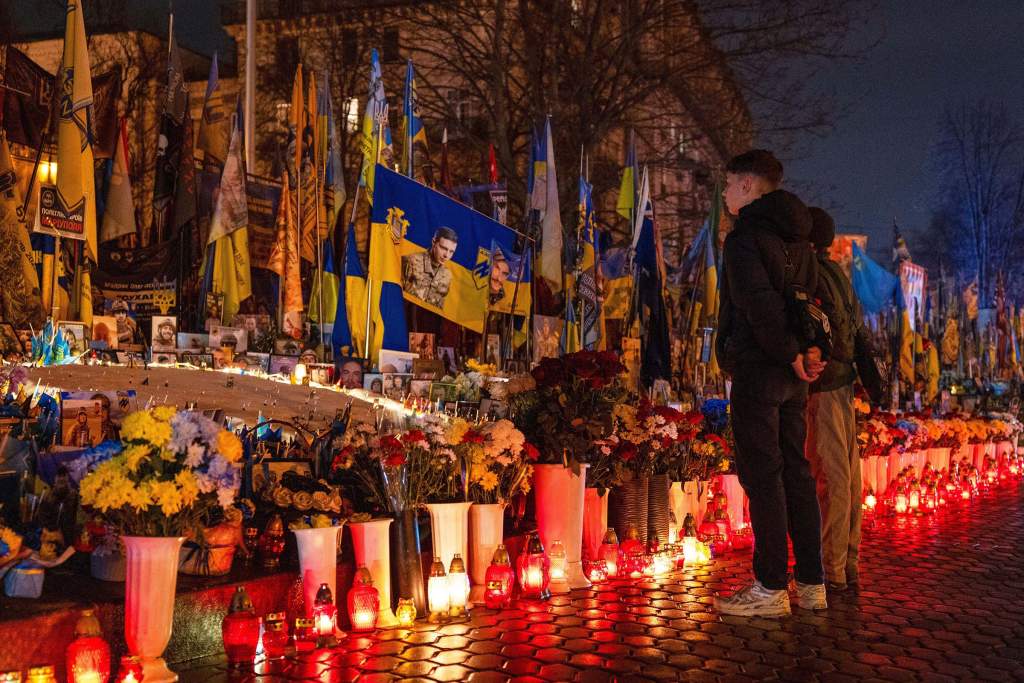
Photo: AP/Dan Bashakov
Could we please meet somewhere warm, my respondent asks as we confirm our interview. The young woman I am arranging to meet is willing to give me her time and share the difficult memories of her life under Russian occupation for my new writing project. The least I can do is ensure she does not have to endure additional physical discomfort during the interview. But a space where you do not have to keep on several layers is hard to come by in Kyiv these days.
Outside, it is -15°C, and with minimal or no heating indoors temperatures drop below any acceptable level. People are told not to come into offices because they are unheated, yet for many, working from home is not an option either: electricity is often unavailable, and frequently enough, there is no running water.
Kyiv is a very modern city.
It always impresses me with its eclectic architecture, revealing its complex past; its hi-tech innovations, which speak of its ability to look to the future.
Having endured four years of relentless Russian bombardment of its energy infrastructure – designed as an act of terrorism against civilians – Kyiv’s residents, as well as those across Ukraine, have found various ways to adapt: from using generators to power businesses to heating bricks inside homes (they retain warmth a little longer).
Every person I meet in Kyiv shares a life hack with me for staying a bit warmer. It is hard to believe these stories originate from living in a 21st Century European city.
“We will manage,” each story I hear ends. “We always do.”
This ability to stay resilient in the toughest of circumstances has played a cruel trick on Ukrainians.
A nation that, only a few years ago, was at best unknown and at worst mistaken for Russian has come to symbolise resilience and defiance around the world.
In the western imagination, Ukrainians are cast as feisty cossacks, able to withstand a brutal Russian bear through sheer will and ingenuity. It is a good plot for a bad film. But that is precisely the problem: for those who do not have to rely on resilience to survive, the war in Ukraine can be watched as just another movie.
“Please don’t use those words, they give me shivers,” one of my friends says as we try to warm ourselves with a cup of tea. “Resilience, defiance, indomitability – we cannot bear those words any more.”
Ukrainians are not characters in a film written to entertain and inspire viewers with their resilience. To survive – just like everyone else – they need heat and electricity, and these cannot be generated through willpower.
They also need adequate air defences to protect their cities, and weapons to push back an enemy prepared to pave every square kilometre it gains with the bodies of its soldiers.
Since they began their full-scale war on Ukraine on 24 February 2022, the Russians have lost more than a million army personnel. In 2025 alone, they suffered approximately 35,000 casualties per month. Their advance is slow (between 15 metres and 70 metres on a good day), and they have occupied less than 1.5% of Ukrainian territory since last year.
All of this pushes the Russian leadership to seek alternative ways of making progress.
With the weather being uncommonly cold this year, the Russians are bent on weaponising winter to fight Ukrainians in their homes – as they continue to fail to defeat them on the battlefield.
The available air defences are insufficient, allowing the Russians to destroy energy infrastructure with the aim of freezing people into submission.
Russia has no intention of confining its war to Ukraine.
One of the easiest targets for Russian weaponisation has been the complacency of the Global North. A small shake-up of Western Europeans – triggered not by Russia’s illegal war in Ukraine, but by the US changing the rules of the game – offered a glimmer of hope that those enjoying peace might begin to realise that it is not guaranteed to last for ever.
Yet, as they began to think about how to protect their own peace, despite much talk of ‘peace negotiations’, there has been no progress towards securing one in Ukraine.
‘Peace’ is another word Ukrainians struggle to stomach these days. Though we do not use it when talking to one another, we have to confront talk of ‘peace deals’ on a daily basis.
“I’d like to start our discussion by asking you why you deal with peace,” said the moderator of an event in Vienna dedicated to the 30th anniversary of the Dayton Accords – a peace deal that brought an end to violence in Bosnia and Herzegovina.
My co-panellists nodded as they jotted something down in their notepads, and I realised I had nothing to say in response to the question.
The room where the discussion was held was decorated with cut-outs of doves – a symbol signifying peace, originally between humans and God and, more recently, among warring nations. I felt immediate discomfort.
Four years into the full-scale war, and 12 since Russia first attacked Ukraine, this symbol – like the word peace itself – is more likely to be triggering than soothing for a Ukrainian.
Those who have never faced a threat to their peace cannot comprehend that fighting is sometimes the only way to secure it
Right from the start there was a proliferation of social media accounts using doves as profile pictures, signalling that they were ‘against war’. More often than not, these displays of peace were limited to a generic statement that equated to ‘for everything good, against everything evil’. They did not even go so far as to condemn the criminality of Russia’s attack on Ukraine.
‘Peace marches’ organised in various western capitals have often focused on opposing the supply of weapons to Ukraine – rather than demanding tougher sanctions or accountability for the aggressor.
In other words, those who have insisted on ‘peace’ have rarely been invested in justice.
“I do not deal with peace, because I have to deal with war,” I said in response to the question – to the raising of eyebrows.
“In fact, I get triggered by the word ‘peace’ and even these doves,” I added, unable to stop myself.
The moderator was taken aback. Once again, I had to state the obvious: “Don’t get me wrong. Ukrainians want peace more than anyone else.”
But shouldn’t it be taken as read that a society in which the vast majority have had close relatives or friends killed or injured in the Russian war, which has gone years without a full night’s sleep because of air raids, which is spending its fourth winter without heating or electricity, and whose sole wish is for Russia to finally leave their country alone, wants peace more than anyone can ever imagine?
But if a peace plan imposed on them time and again amounts essentially to a plan for surrender, is it little wonder that even an innocent cut-out of a dove is likely to send shivers down their spines?
Later that evening, someone told me I had to “give peace a chance”. My words had fallen on deaf ears again.
Those who have never faced a threat to their peace cannot comprehend that fighting is sometimes the only way to secure it.
Those who have never had to survive relying on sheer resilience, will continue to romanticise it. And those who have never lived under the shadow of occupation will struggle to truly understand the meaning of freedom.
The place where I meet my interviewee is warm enough by Kyiv standards to hold a conversation, though we both keep our layers on.
She is tense as she recounts the hardships of her life under Russian occupation, yet she recalls the day she escaped to Kyiv with evident joy.
“I was so happy to be here,” she says. “I don’t know how else to describe it. Just a real sense of uplift. I was tired, I hadn’t slept, I hadn’t eaten properly. But I kept going. My legs did not feel heavy at all, and it was like I had found a second wind and was pushing myself forward. And that, really, is about freedom. Because you only understand it when you lose it.”
I do not have the heart to tell her that barely a day passes without someone in the west insisting that Ukrainians must give up territory – including the city she comes from – if they want to “give peace a chance”.
We finish the interview and walk to the nearest metro station along the icy streets of Kyiv. It is dark in the total blackout and bone-crunchingly cold. We are lucky: the metro is still running (it will collapse without power in just a couple of days).
I watch her leave and hope for a day when this young woman, and my fellow Ukrainians, will not have to rely on resilience simply to stay alive.
As we step into the fifth year of the full-scale war, Ukrainians struggle to find new ways to explain to the world that only decisive, collective, action against the aggressor can bring about peace. That it is unfair to expect Ukrainians to survive simply because they somehow always do.
I wonder if there is a way for those sitting in unheated apartments to communicate the urgency of the situation to people who grumble about high energy bills. Then I remember the very last part of our interview.
When I asked the young woman if there was anything she wanted to share that I hadn’t asked about, she said: “I simply want – how shall I put this – I want politicians in other countries to finally understand the phrase ‘never again’.”
I tell her I will do my best to deliver her message. I do not tell her I cannot guarantee that it will be heard.
Olesya Khromeychuk, a historian and writer, is the director of the Ukrainian Institute London